
Konverge AI describes itself as a company working with enterprise AI and data capabilities, including generative AI and data engineering. Someone searching for Konverge AI may be researching a services partner rather than looking for a general-purpose chatbot. That changes the questions worth asking.
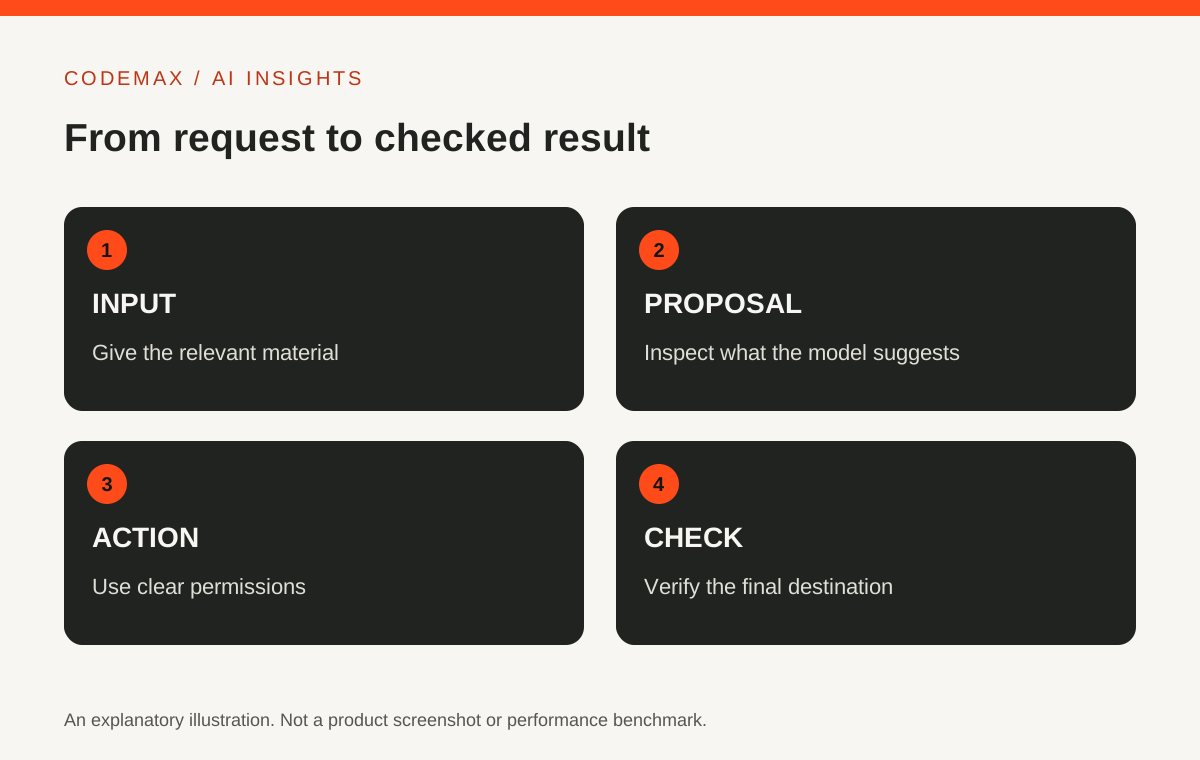
Begin with the official description
The company's about and services pages explain its positioning. Use them to identify the areas relevant to your project, then ask for detail about the specific work you need. Broad capability statements are a starting point for discussion, not evidence that a proposed implementation will meet your requirements.
This article is a source-based overview and evaluation guide. It is not a hands-on review of a Konverge AI implementation, a customer testimonial or a claim of affiliation with CodeMax. No project outcome is implied by the company's service descriptions.
Define the deliverable before choosing the technology
Write a concrete problem statement and the output you expect. A document-search prototype, a data pipeline and an action-taking assistant are different deliverables. Identify the users, source systems and the decision the output will support.
Ask what the pilot will include and exclude. For example, does it use sample data or connect to production systems? Does it demonstrate a concept or include operational support? Clear boundaries prevent a successful demonstration from being mistaken for a complete deployment.


Request a data and access plan
List the data required, where it will be processed and who can access it. Ask how permissions in the source systems will be preserved. A technically correct answer is not acceptable if it reveals information to the wrong user.
Use a representative but controlled dataset for the initial evaluation. Include cases with missing information and conflicting records. Those examples often reveal more about the proposed workflow than an idealised demo containing only clean inputs.


Agree how success will be measured
Set a baseline using the current process. Decide which outcomes matter: accuracy, review effort, completion time or another task-specific measure. Avoid a single vague objective such as improve efficiency without a method for observing it.
Ask how errors will be recorded and who decides whether the result is acceptable. Include the effort required to correct mistakes and maintain the system. A pilot can reveal useful limits even when it does not justify immediate expansion.
Clarify ownership and ongoing responsibilities
Before moving beyond a trial, document the handover, access, dependencies and support arrangements. Establish who updates the system when models or source data change. Make sure the organisation can locate the implementation notes and understand the operating process.
The same approach applies when evaluating any AI services company. A useful partnership connects a defined problem to a measurable, maintainable result. Company background can inform the shortlist, but the project evidence should drive the decision.
Sources and further reading
Source-based explainer first researched on 30 September 2026; company sources and image reuse terms rechecked on 20 October 2026. Service descriptions and availability can change. Examples are illustrative unless identified as reported research.
Explore more AI news and insights or browse the CodeMax journal.