
Deep learning is a branch of machine learning that uses neural networks with multiple hidden layers. Machine learning sits within the broader field of AI. The terms are related, but they are not interchangeable: not every AI system uses deep learning, and not every machine-learning method is a neural network.
Think in terms of input and output
A model receives an input and produces an output. In an image-classification example, the input represents an image and the output may be a set of category scores. In another task, the output could be a number or a sequence of text.
A neural network contains layers of adjustable calculations. During training, those parameters are changed to improve performance according to an objective. Google's machine-learning course explains components such as nodes, hidden layers and activation functions in more detail.

Training is not simply memorising a rule written by a person
A developer chooses the model structure, data and training process, but the learned parameters emerge through optimisation. That can help with patterns that would be difficult to describe through a short hand-written rule.
However, learning from examples also creates dependencies on those examples. If the training material misses an important condition, the model may perform poorly when that condition appears later. More complicated architecture does not automatically solve a poor data problem.
Keep training and evaluation separate
A model can perform well on examples it has already seen and less well on new ones. Evaluation uses separate data to investigate how well the learned behaviour transfers. A validation set helps guide model choices during development; a separate test set checks the selected model afterwards. The separation must be meaningful, not merely two folders containing almost identical examples. Google’s guide to splitting datasets also warns that repeatedly tuning against a test set can undermine that separation.
For an intuitive exercise, imagine learning to recognise birds from photographs taken against one background. If every new photograph uses a different setting, the task may become harder. The model could have relied on an accidental pattern that the original examples did not expose.

These two photographs are not a training dataset or a benchmark. They make a narrower point visible: pictures of the same kind of subject can differ substantially. A real evaluation needs enough representative, independently held-out examples to investigate performance.
Understand the objective before reading a score
A training objective tells the system what is being optimised. A useful application may require more than that single measure. Accuracy, latency, resource use and the consequences of different errors can all matter.
Ask whether the reported metric reflects the real task. A system that gets most easy cases right may still fail on the cases that matter most to users. Inspect examples of errors rather than looking only at a summary percentage.
Learn through a small experiment
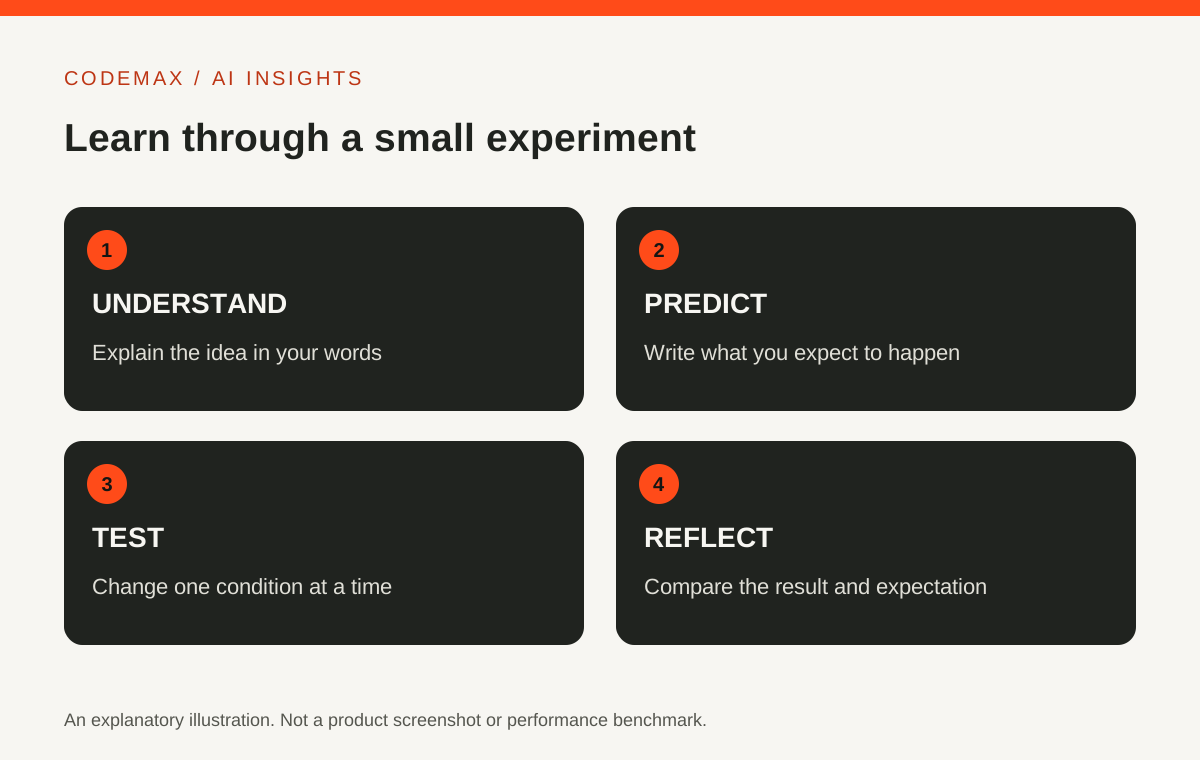
If you want to study the mechanics, begin with an introductory course and a small model you can inspect. Change one condition at a time and record the result. Start with a simple baseline before adding layers or more complex training choices.
You do not need to become a researcher to read AI claims more carefully. Knowing the difference between training, evaluation and deployment already helps. Deep learning is a powerful family of methods, but its usefulness depends on the problem, data and evidence surrounding the model.
Sources and further reading
- Google: Neural networks course module
- Google: Nodes and hidden layers
- Google: Dividing datasets
- Google: Accuracy, recall and precision
Source-based explainer originally researched on 30 September 2026; technical sources and image rights rechecked on 16 October 2026. The two USFWS photographs are public-domain contextual images, resized and converted to WebP without changing their subjects. CodeMax has not trained or tested a model on these images. No endorsement by Google or USFWS is implied.
Explore more AI news and insights or browse the CodeMax journal.